
Call Us :
+8618925446207
Email Us :
marketing@databeyond.com
 English
 Français
 Deutsch
 Español
 日本語
日本語 中文
中文





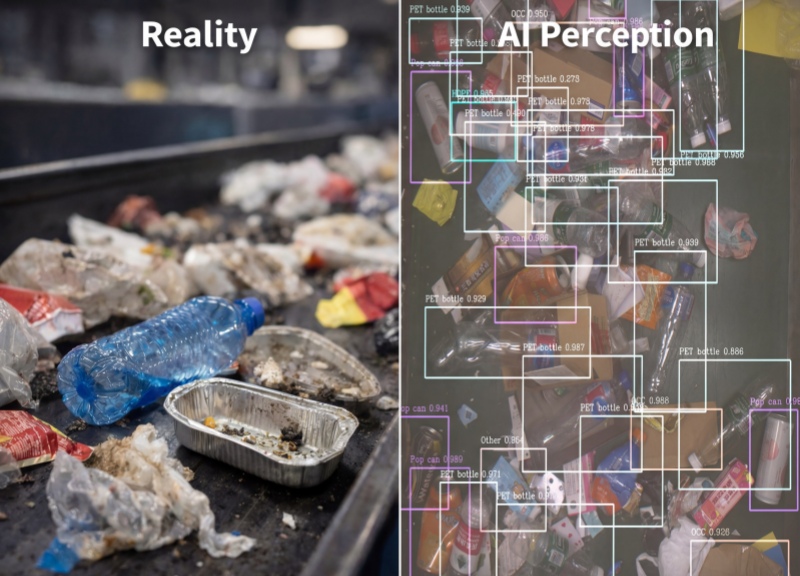
Europe's 2035 deadline looms: a legally binding 65% municipal solid waste (MSW) recycling rate under the revised Waste Framework Directive. Yet today's average hovers near 48%—not because citizens refuse to sort, but because mixed MSW streams arriving at Material Recovery Facilities (MRFs) remain a chaotic cocktail of 200+ material types, where a single contaminated PET bottle can downgrade an entire bale's value by 30%.
The Hidden Bottleneck Isn't Collection—It's Recognition
Traditional optical sorters fail MSW's ultimate stress test: they see a distorted shampoo bottle with residual label as "noise," not a recoverable HDPE resource. They misread a Pepsi logo printed on a milk jug as a beverage container, triggering cross-contamination cascades. Why? Conventional AI relies on rigid template-matching trained on pristine lab samples—useless when facing real-world MSW realities: crushed containers, food residue, multi-layer packaging, and unpredictable deformations.
How AI Rewrites the MSW Sorting Equation
DATABEYOND' s breakthrough lies not in collecting more physical samples, but in intelligently simulating reality. Our self-developed AI large model features a proprietary data engine that performs 2D/3D visual data interchange—generating millions of virtual material states (rotation, folding, crushing, staining) and fusing them with real hyperspectral captures across 256 spectral bands. This synthetic-to-real training pipeline enables the system to recognize a material's identity rather than memorizing its appearance: a crumpled PP film, a label-obscured HDPE bottle, or a food-soiled tray are all identified by their intrinsic spectral signature—not by matching a "perfect" reference image.
The outcome? 99.5%+ purity on target fractions under real-world contamination levels (30–40%), with recovery rates for PET, HDPE, and translucent PP films exceeding conventional NIR sorters by 25–30%.
The Silent Advantage: Accuracy That Compounds—At Zero Cost
Unlike legacy systems that freeze in capability after installation, every FASTSORT unit contributes anonymized recognition patterns to our central AI engine. When the model learns to distinguish a translucent yogurt cup from PET clamshells in one facility, that intelligence propagates globally via over-the-air updates—without hardware changes or service fees. Clients who deployed systems in 2024 now enjoy 3.2% higher recovery rates on flexible films purely through software evolution. This isn't maintenance—it's compounding intelligence baked into the ownership experience.

From Compliance to Competitive Edge
MRF operators leveraging AI-hyperspectral lines report:
●28% higher recovery of high-value polymers (PET/HDPE/PP) vs. conventional sorters
●Superior handling of translucent & multi-layer materials: 256-band hyperspectral resolves spectral nuances invisible to RGB/NIR systems
●14-month ROI through monetization of previously landfilled streams (e.g., mixed films now command €520/ton in EU rPlastic markets)
●Future-proofing: As EU Packaging Directive 2030 mandates 65% recycled content, facilities with adaptive AI avoid mid-life retrofits
The Bottom Line
Hitting 65% isn't about building more bins—it's about deploying smarter eyes at the sorting line's critical decision points. When AI stops demanding "perfect samples" and starts embracing real-world chaos through intelligent simulation, MSW transforms from municipal liability into urban mining opportunity. The technology exists. The question is: will your facility be extracting value—or still burying it?
 IPv6 network supported
Leave A Message
Scan to Wechat :

Scan to WhatsApp :