
Call Us :
+8618925446207
Email Us :
marketing@databeyond.com
 English
 Français
 Deutsch
 Español
 日本語
日本語 中文
中文





From "Relying on Eyes" to "Relying on Algorithms": A Silent Manual
Sorting is Becoming an Invisible Ceiling on Capacity and Quality
In the recycled plastics value chain, the initial sorting of PET bottle flakes is a critical step that determines the purity, value, and marketability of recycled materials. For a long time, many recycling projects have relied on manual sorting—with low startup barriers and minimal initial investment, making it appear flexible and efficient. However, as global quality standards for recycled materials continue to rise and feedstock complexity increases, this model relying on human judgment and experience is revealing systemic bottlenecks.
In some countries, the average tenure of experienced sorters is less than six months, and frequent staff turnover leads to significant fluctuations in product quality on the production lines. In other regions, young workers are generally unwilling to work in sorting facilities, leaving companies struggling with a persistent dilemma: difficulty in hiring and retaining staff. Even more pressing, some countries have implemented stricter labor regulations or raised minimum wage standards in recent years, putting continuous pressure on the operating costs of labor-intensive recycling projects and squeezing profit margins.
The more mixed the incoming feedstock, the more “blind” the human eye becomes.
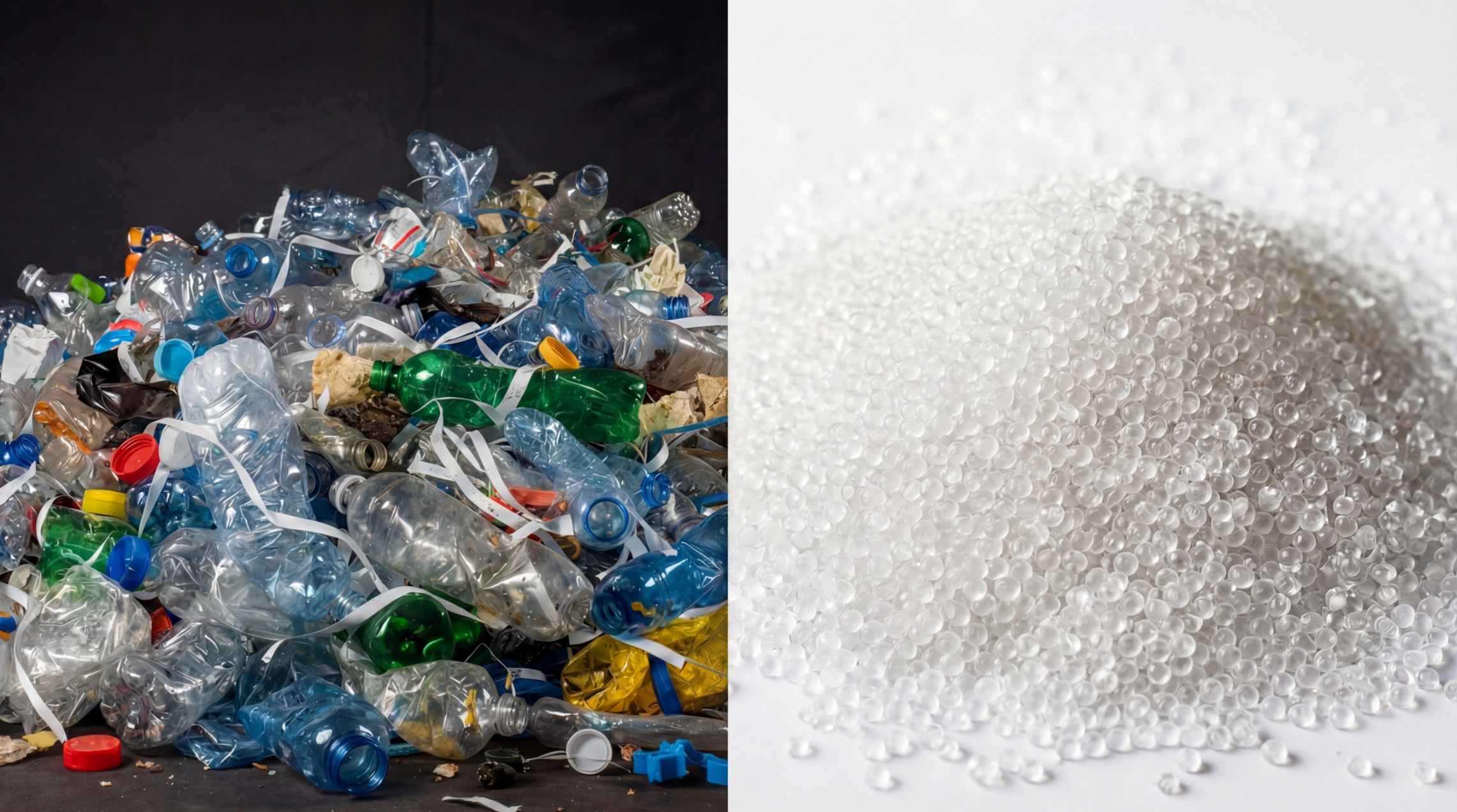
Today’s PET recycling feedstock is no longer limited to simple, clear beverage bottles. Mixed packaging, colored bottles (blue, green, red, opaque), non-standard containers, and even non-PET materials such as PVC, PP, and PS are increasingly present, posing unprecedented challenges to sorting accuracy. Human operators can only rely on surface features like color and shape, making it impossible to identify the material’s intrinsic properties. Misjudgments are common, and on high-speed production lines, missed detections are almost inevitable.
This issue is particularly pronounced in some emerging recycling markets, where waste sorting systems are still underdeveloped and incoming feedstock is highly heterogeneous, with a wide variety of impurities appearing in no predictable pattern. Manual sorting is not only inefficient, but residual contamination often exceeds acceptable limits, causing entire batches of recycled material to be rejected by high-end downstream clients. This leads to direct financial losses and can even jeopardize long-term business relationships.
Optical Sorting Is Not a Replacement for Labor, but a Reconstruction of Sorting Standards
Facing this common challenge, an increasing number of forward-looking recycling companies are turning to optical sorting technology. This represents not merely an equipment upgrade, but a fundamental rethinking of sorting logic—shifting from “experience-driven” to “data-driven.”
Through an intelligent closed loop of “perception–judgment–execution,” optical sorting transforms a process once reliant on human experience into a replicable, predictable system of decision-making.
●The “brain” leverages a massive database of recycled materials and proprietary deep learning algorithms to simultaneously analyze the shape, color, and material type of items at high speed.
●The “eyes” consist of ultra-high-definition 8K line-scan cameras and a 256-band line-scan near-infrared hyperspectral imaging system, which in most complex feedstock scenarios can reduce interference from surface coatings and colors, and extract key spectral features for material identification.
●“Judgment” is provided by AI algorithms that fuse multidimensional data in real time, delivering stable and consistent sorting decisions.
Within this system, equipment can efficiently separate PET from various impurities—including differently colored bottles—with sorting accuracy ≥99.6%, far exceeding the physical limits of human eyes and traditional methods.
Beyond precision, the technology enhances operational stability and efficiency. Optical sorting can run continuously, unaffected by human fatigue, mood, or shifts, while lines that once required multiple workers now operate stably with just a few staff handling feeding and maintenance, greatly reducing labor costs and management complexity.
Crucially, predictable sorting shifts the value logic of recycled materials: companies focus less on “how much is collected” and more on “consistently producing high-purity feedstock.” With regulations like the EU PPWR and U.S. Recycled Plastics Content Act setting purity and compliance as market thresholds, sorting technology has become a key capability for accessing high-end markets.

From “Able to Do” to “Able to Do Reliably”: A Mark of Recycling Industry Maturity
Many upgrading recycling lines previously relied on more than 10 workers across multiple shifts for manual sorting. While the lines could operate, sorting results fluctuated over time, making it difficult to meet the demands of brand supply chains or high-grade recycled material systems. The challenge is not whether materials can be sorted, but whether the results are consistent. Sorting that heavily depends on human experience inevitably leads to quality variability, limiting companies’ ability to move into higher-value markets.
In some pioneering lines, this situation is changing. With high-precision optical sorting handling key stages, tasks once requiring multiple operators are now centralized in the equipment. Sorting consistency has improved significantly, and impurity control is more manageable. This not only boosts efficiency but also transforms operations: predictable and stable quality allows companies to take on long-term orders and clearly define delivery standards. As one industry professional noted, “In the past, we worried about batch variations when serving major clients. Now that results are stable, we can confidently guarantee quality.”
Leveraging Technological Certainty to Address Industry Uncertainty
At the macro level, this shift reflects the recycling industry’s renewed emphasis on “certainty.” The global recycled plastics market is expected to surpass USD 80 billion in 2026, with the industry transitioning from “scale expansion” to “quality improvement,” where regulatory compliance, technological innovation, and stable supply have become core competitive factors.
Powered by AI-driven hyperspectral technology, DATABEYOND drives the shift from “sorting by eye” to “sorting by algorithm,” breaking through the limitations of manual sorting and delivering stable, high-quality solutions for the industry, breaking through the bottlenecks of manual sorting and providing the industry with stable, high-quality solutions. This leap from “able to do” to “able to do reliably” represents the true evolution of the recycling industry and injects sustainable momentum into the high-end global PET recycling market.
 IPv6 network supported
Leave A Message
Scan to Wechat :

Scan to WhatsApp :