
Call Us :
+8619011236835
Email Us :
marketing@databeyond.com
 English
 Français
 Deutsch
 Español
 日本語
 中文





Gongye Technology’s independently developed AI hyperspectral blended-textile optical sorter (FASTSORT™ TEXTILE) has been named to the 2026 Fortune China Best Design List. With AI-powered hyperspectral fusion technology, it advances T2T recycling and provides standardized raw material classification for the recycling of waste textiles.
T2T: Textile-to-Textile, generally referring to recycling waste textiles into new textile fibers or textiles.
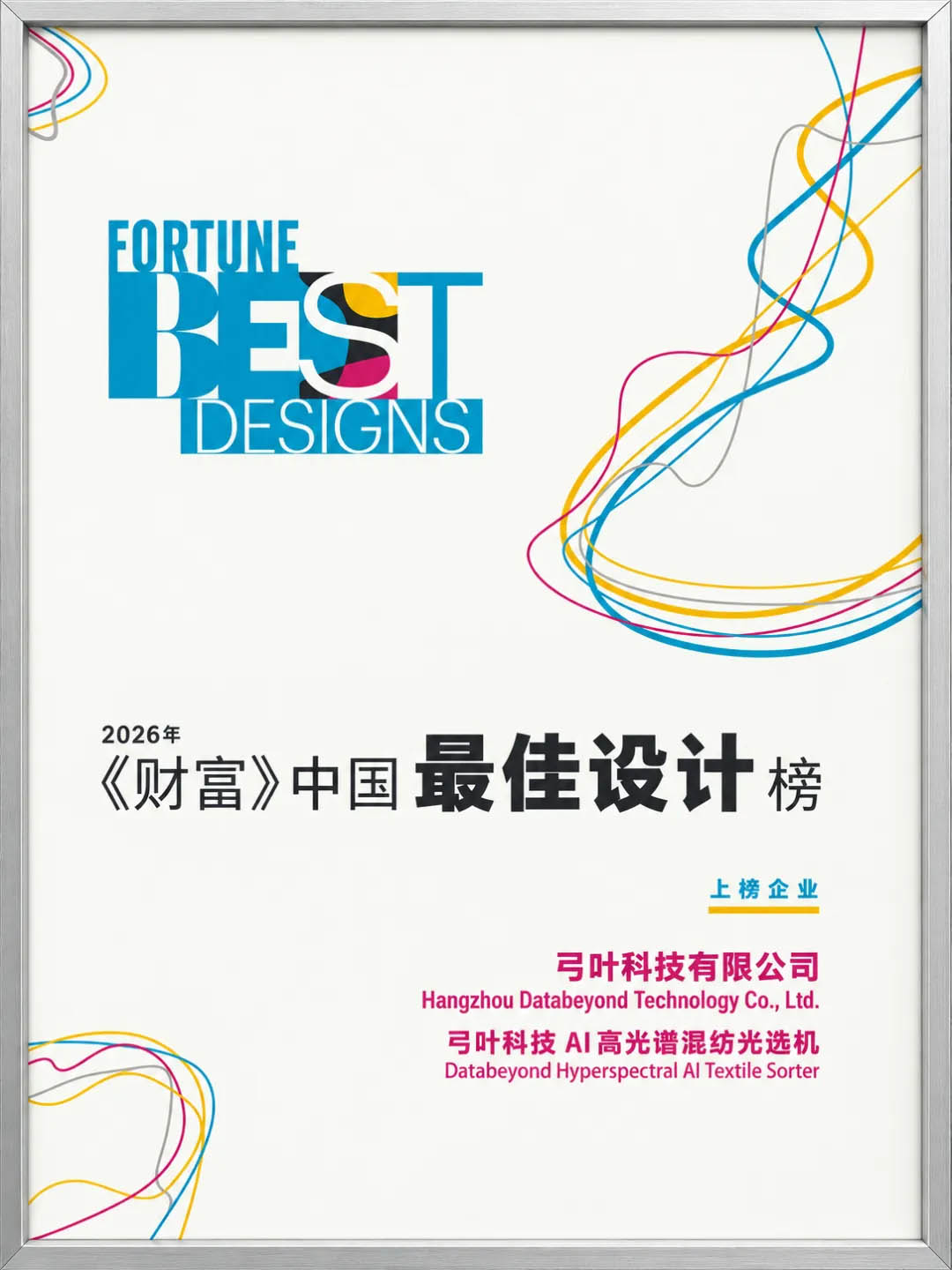
This design addresses a key question in textile waste recycling: how can waste textiles with varying compositions, colors, and forms be converted into recycled raw materials that downstream users can utilize consistently?
Sorting Determines the Utilization Value of Textile Waste Recycling
The recycling pathway for waste textiles is closely related to fiber composition, blend ratio, color, and impurities. For garments that look similar but have complex compositions, manual observation and experience alone cannot consistently meet the raw-material consistency requirements of fine-grained recycling.
Unclear composition and insufficiently detailed sorting increase the difficulty of downstream processing and may also divert materials with higher utilization value into low-value processing channels.

Gongye Technology separates materials by dimensions such as material type, composition requirements, and color, matching different materials to suitable utilization pathways and creating conditions for high-value recycling.
Whole-Garment Diversion and Shredded-Fabric Purification Cover Different Material Forms
For the two material forms—whole garments and shredded materials—Gongye Technology has developed corresponding recognition and processing solutions.
Whole-garment stage: 256-band hyperspectral and AI vision technologies classify garments while keeping them intact, according to specified composition requirements such as polyester content and cotton content, as well as color and style, so that compliant materials can be diverted early, preserving more options for downstream processing.
Shredded-fabric stage: sorting focuses on purifying target materials and removing impurities. Through “positive sorting + reverse sorting” dual-machine collaboration, target materials are extracted, and impurities such as heterogeneous materials, zippers, and buttons are further removed to ensure raw material purity for downstream processing.
The full line integrates feeding, material loosening, intelligent sorting, and baling, achieving 100% automation across the entire process and supporting continuous, large-scale production in textile waste recycling.
Previously, the AI hyperspectral blended-textile optical sorter was selected for the Special Mentions category of TIME’s 2025 Best Inventions. Its inclusion in the Fortune China Best Design List once again brings attention to this technology designed for the practical needs of textile waste recycling.
In the future, Gongye Technology will continue to improve the recognition capability of textile waste sorting, full-line stability, and large-scale delivery capability; strengthen collaboration with upstream and downstream recycling enterprises; optimize sorting solutions based on actual processing needs; and enable more waste textiles to be given suitable recycling opportunities.
 IPv6 network supported
Leave A Message
Scan to Wechat :

Scan to WhatsApp :