
Call Us :
+8618925446207
Email Us :
marketing@databeyond.com
 English
 Français
 Deutsch
 Español
 日本語
日本語 中文
中文




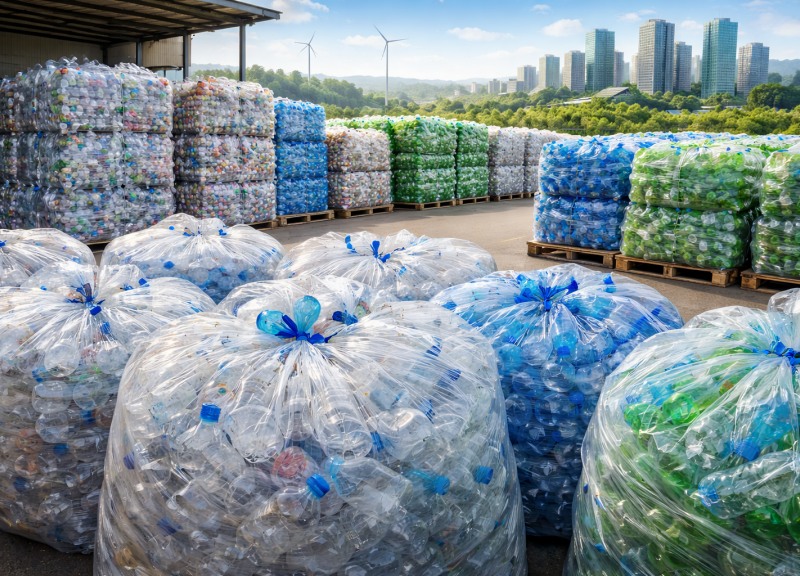
By the end of 2025, the global recycled plastics market is entering a phase of explosive growth—expected to expand from USD 60–85 billion today to more than USD 140 billion by 2032. Behind these impressive numbers lies an even greater opportunity: demand for high-quality recycled plastics is surging, while supply remains severely constrained. This imbalance represents the most critical window for recycling companies to achieve a step change in profitability.
The Dead End of the Linear Economy vs. the Golden Track of the Circular Economy
The traditional “take–make–dispose” model is rapidly collapsing. Landfilling or incinerating plastics not only wastes valuable resources, but also generates substantial environmental and carbon costs. Recycling just one ton of PET bottle flakes can reduce CO₂ emissions by approximately 79% compared to producing virgin plastic.
A true circular economy, by contrast, transforms waste plastics into high-value secondary raw materials—such as food-grade rPET. These premium materials command higher prices and secure long-term supply contracts with major brand owners. Global leaders including Coca-Cola, PepsiCo, and Unilever have publicly committed to using at least 50% recycled plastic in their packaging by 2030. Meanwhile, the EU’s Packaging and Packaging Waste Regulation (PPWR) mandates that beverage bottles contain 25–30% recycled content starting in 2025.
This is no longer a compliance burden—it is a competitive advantage. High-purity recycled materials often sell at a premium. By 2030, the global supply gap for recycled plastics is expected to reach tens of millions of tons, driving sustained price increases. Those who can deliver a stable supply of high-quality recyclate will be the first to capture this opportunity.
The True Game Changer: AI and Hyperspectral Intelligent Sorting
The biggest bottleneck in achieving a circular economy has always been sorting. Conventional optical sorting—based on color or standard near-infrared—struggles with mixed-color plastics, multilayer films, labeled items, or lightly contaminated materials. The result is low purity, high rejection rates, and downcycled recyclate.
AI-powered hyperspectral sorting fundamentally changes this equation. By capturing hundreds of spectral bands, it generates a unique “spectral fingerprint” for every plastic item, enabling highly accurate identification. Key advantages include:
●Extreme precision: Reliable identification of complex materials (PET, PP, PE, including mixed colors or lightly contaminated plastics), with sorting purity consistently exceeding 99%.
●Higher yield: Recovery rates increase by 20–30%, significantly reducing waste and maximizing material value.
●Efficient automation: Throughputs of several tons per hour, with labor costs reduced by up to 40%.
●True bottle-to-bottle circularity: Enables the production of food-grade rPET that meets the most stringent international standards and can be supplied directly to brand owners.
Early adopters have already achieved payback periods of just two to three years, driven by reduced losses, higher selling prices, and more stable supply chains.
Proven Results from Industry Leaders
An increasing number of recyclers are now building high-efficiency circular production lines—processing tens to hundreds of tons per day—powered by advanced AI optical sorting systems. As the market leader in whole-bottle optical sorting in China, Databeyond’s solutions—including hyperspectral film sorting, whole-bottle plastic sorting, and bulky mixed-material sorting—have helped partners significantly improve profitability while moving toward near-zero waste operations.
Supported by continuous R&D at our Embodied Intelligence Research Institute, we will continue to push the boundaries of recycling technology—bringing smarter, more efficient embodied AI innovations to the industry and transforming environmental pressure into sustainable profit.
Now Is the Time to Act
The transition from traditional recycling to a circular economy is no longer a distant vision—it is happening now, driven by regulation, brand commitments, and market forces. Recycling companies that invest early in precision sorting technologies will be the first to capture the premium value of high-quality recycled materials and fundamentally reshape their future.
Are you ready to turn waste plastics into real profits and lead the zero-waste era? Contact us to explore how AI-powered hyperspectral sorting can unlock breakthrough growth for your business.
The circular loop is closing—and the opportunity is right in front of you.
 IPv6 network supported
Leave A Message
Scan to Wechat :

Scan to WhatsApp :