Call Us :
+8618925446207
Email Us :
marketing@databeyond.com
 English
 Français
 Deutsch
 Español
 日本語
日本語 中文
中文




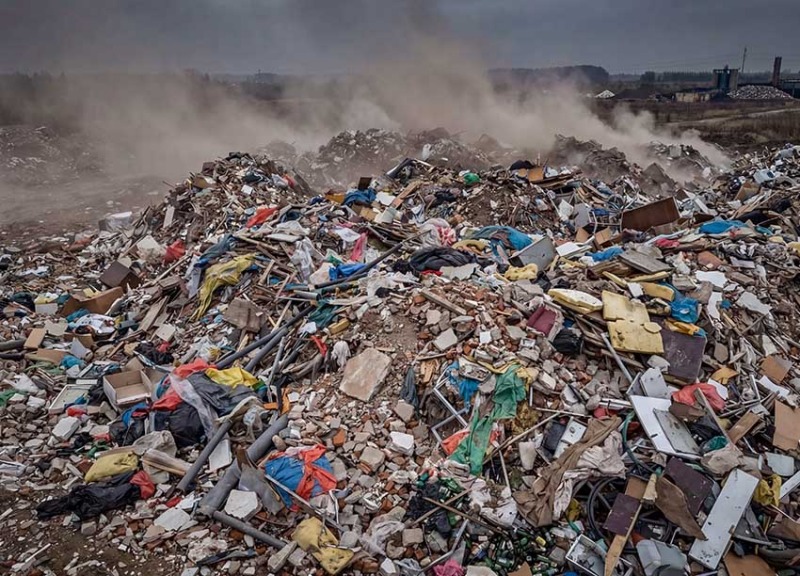
Under the global wave of urban construction and renewal, Construction and Demolition (C&D) waste has become a core component of municipal solid waste (MSW). In China alone, the annual discharge has surpassed 3.5 billion tons, accounting for 30%-40% of the total urban waste. Due to its complex composition and the extreme difficulty of sorting, this type of waste not only puts immense pressure on urban ecosystems but also remains a vast "underutilized reservoir" of resources that struggles to achieve high-value utilization.
I. Undervalued Resources Trapped by Sorting Bottlenecks
Public perception of C&D waste is often limited to "bricks and rubble." However, these seemingly useless materials are actually an undervalued treasure trove—nearly 90% of the components can be repurposed into raw materials for production and construction.
C&D waste is generally classified into two categories: Construction Waste, primarily consisting of concrete blocks, gravel, bricks, and soil; and Renovation Waste, which is far more complex. In addition to sand and cement fragments, renovation waste contains dozens of materials such as plastic pipes, decorative films, waste wood, glass, metals, paint buckets, textiles, and foam. Theoretically, masonry and concrete can be processed into recycled aggregates to replace natural sand and gravel, while recyclables like plastics and metals can be purified for circular regeneration.
However, in practice, the resource utilization rate has long remained low, with the core bottleneck being the sorting stage.
Traditional methods often follow the obsolete path of "simple crushing + coarse screening + landfilling." Manual sorting is not only inefficient and inconsistent but also exposes workers to dust, noise, and hazardous substances, leading to increasing labor shortages and costs. Conventional mechanical screening only achieves simple particle size classification. It fails to precisely remove impurities like plastics, wood chips, glass, and metals mixed within the aggregates.
As a result, the recycled aggregates produced are of low purity and poor performance, limited to low-value applications like roadbed backfilling. More critically, large amounts of light materials such as PP/PE films and foam in renovation waste are difficult to separate using traditional means. Irresponsible landfilling contaminates soil and groundwater, while simple incineration releases toxic gases like dioxins.
Without precise and efficient sorting technology, the resource utilization of C&D waste remains a mere concept.
II.Breaking the Deadlock: DATABEYOND’s C&D Waste Resource Utilization Solution
While the industry struggled with the challenges of "sorting, purification, and high-value utilization," DATABEYOND has found a breakthrough through its years of expertise in AI intelligent sorting technology.
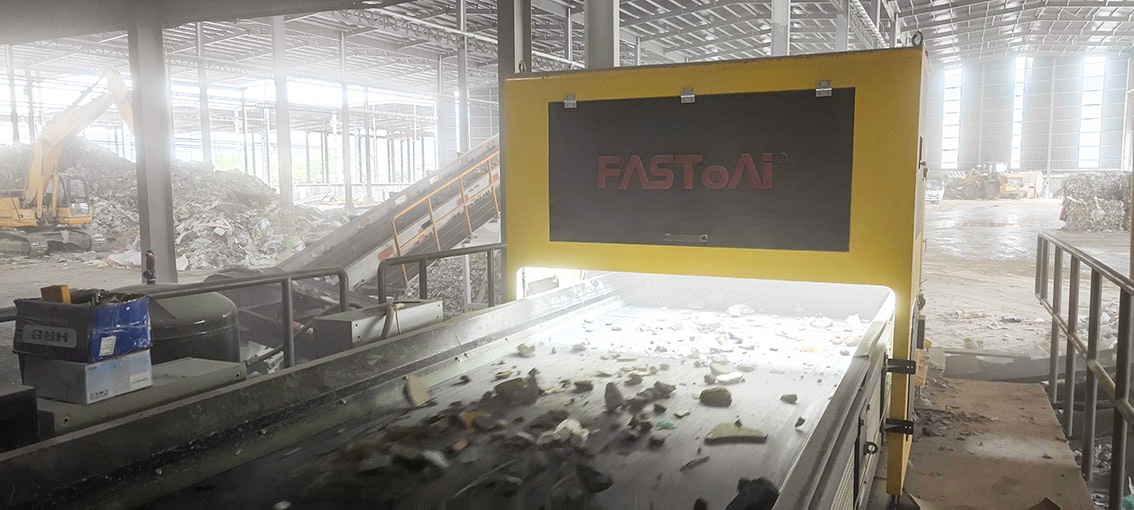
As a global leader in intelligent sorting for front-end recycling, DATABEYOND has spent eight years deeply cultivating AI + Hyperspectral technology, building an industry-leading Solid Waste AI Big Data Engine. Our equipment has been deployed in over 40 countries and regions. To address the pain points of C&D waste, DATABEYOND launched the specialized FASTSORT-CDW-AI-SPEC. Trained on massive samples, the AI algorithms can achieve millisecond-level precision in identifying various materials after crushing. Even small plastic flakes, wood chips, glass fragments, and metal particles mixed in aggregates can be accurately captured, with a stable sorting accuracy exceeding 95%.
In actual production lines, the core value of the FASTSORT-CDW-AI-SPEC is reflected in two key areas:
1.High-Purity Recycled Aggregates for Closed-Loop Construction
The FASTSORT-CDW-AI-SPEC can efficiently remove various impurities such as metals, glass, plastics, and wood chips from aggregates after crushing and primary screening. The resulting high-quality recycled aggregates not only meet the requirements for basic scenarios like roadbeds but also fulfill the raw material standards for mid-to-high-end construction applications, such as commercial concrete, recycled mortar, permeable bricks, and precast components. This breakthrough truly achieves a "from construction, back to construction" closed-loop cycle, reducing natural sand mining and significantly lowering carbon emissions in building material production.
2.Precise Sorting for High-Value Utilization and Green Energy For plastic waste
The most difficult part of renovation waste to handle—the FASTSORT-CDW-AI-SPEC can precisely identify and purify different materials like PP and PE films, pipes, and foam. This solves the long-standing industry challenge of "incomplete separation of light materials." Sorted high-purity plastic waste has multiple utilization paths: high-quality plastics can be directly pelletized for recycling, while films that are difficult to recycle mechanically can be converted into green energy like fuel oil and gas through pyrolysis technology. This model solves plastic pollution at the source while transforming a disposal burden into an energy resource.
Furthermore, the FASTSORT-CDW-AI-SPEC perfectly adapts to different processing scales, operating stably 24/7 with efficiency exponentially higher than manual labor. Combined with DATABEYOND’s self-developed digital management system, real-time monitoring of sorting data and equipment status is achieved, leading C&D waste utilization into the era of intelligence and precision.
Empowering the Circular Economy for a "Waste-Free City"
With intelligent sorting technology at its core, DATABEYOND has broken the technical bottlenecks that have long constrained the industry, turning C&D waste from "landfill fodder" into a circular resource bank.
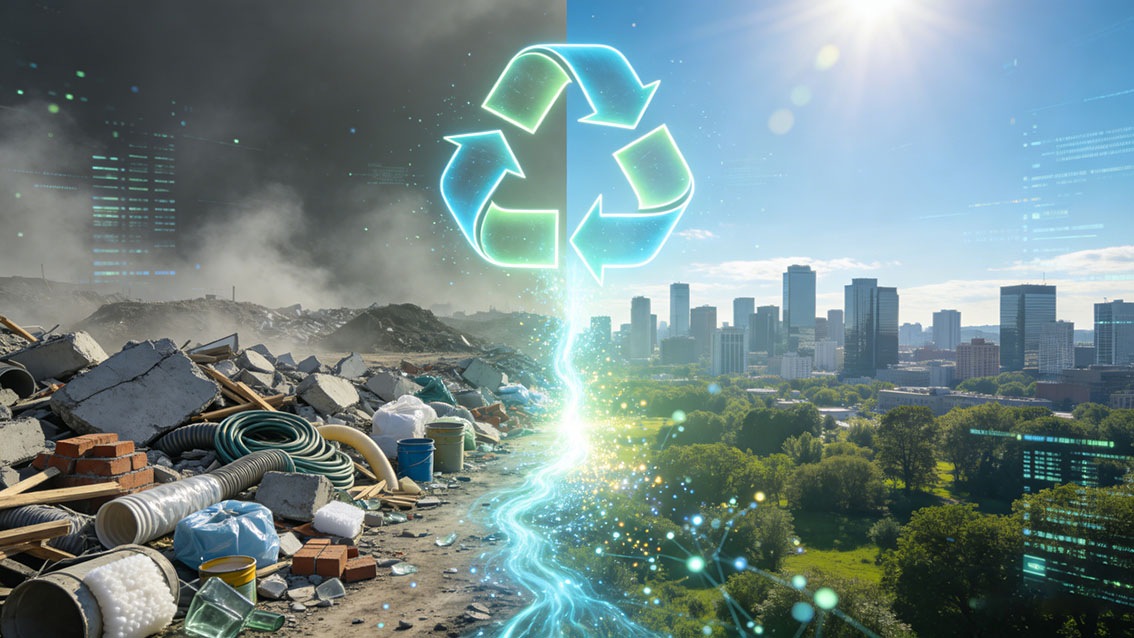
In the future, as intelligent sorting technology continues to iterate and scale, C&D waste will shed its label as an "urban malady" and become a valuable, renewable resource for urban development. DATABEYOND remains committed to contributing Chinese Green Tech Power to global solid waste utilization and sustainable urban development.
 IPv6 network supported
Leave A Message
Scan to Wechat :

Scan to WhatsApp :