
Call Us :
+8618925446207
Email Us :
marketing@databeyond.com
 English
 Français
 Deutsch
 Español
 日本語
日本語 中文
中文





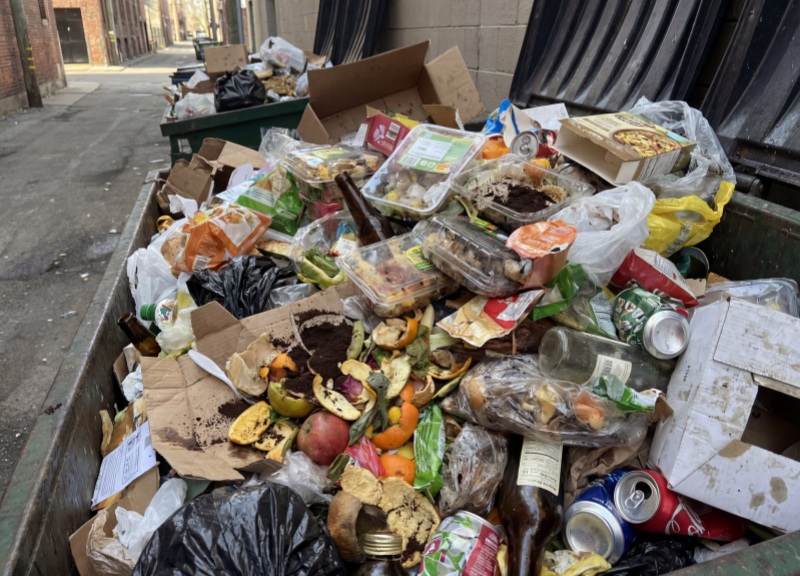
Mixed municipal solid waste is the most realistic—and most unforgiving—testing ground for sorting systems
Among all waste streams, mixed municipal solid waste (MSW) is often labeled as “dirty, chaotic, and uncontrollable.” From an engineering perspective, however, its true value lies elsewhere:
it is the only scenario where material complexity, operational uncertainty, and long-term stability are simultaneously imposed on a system. Unlike PET washing lines, single-polymer streams, or relatively standardized industrial waste, MSW never offers ideal input conditions. Its composition, state, and behavior are in constant flux.
The challenge of MSW is never just about “whether it can be sorted”
In real-world operations, the challenges MSW presents to sorting systems manifest across three critical dimensions:
● Extreme material heterogeneity
Plastics, paper, metals, organics, and composite materials are interwoven. Fragmentation, overlap, and deformation are common, making it difficult for any single recognition logic to achieve comprehensive coverage.
● Severe environmental and state disturbances
High moisture, heavy contamination, adhesion, and organic residues directly compromise sensor signal stability. Recognition performance observed under test conditions can quickly deteriorate in real operating environments.
● System fragility under scaled throughput
As throughput increases, misclassifications, latency, and execution deviations are amplified exponentially—ultimately resulting in system instability, blockages, and efficiency loss. Therefore, in MSW scenarios, the real question is never “Can this machine identify a specific material?” but rather: Does this system possess engineering-level tolerance and the ability to deliver sustained, reliable output?
FASTSORT-MSW: Redesigning sorting logic from a system perspective
Databeyond’s core philosophy behind FASTSORT-MSW is not the pursuit of a single extreme parameter. Instead, it focuses on rethinking how the entire sorting system operates under MSW’s inherent uncertainty.
1. From “recognition equipment” to “system perception”
FASTSORT does not rely on a single sensor to make decisions. Instead, it integrates multi sensor data to form a holistic understanding of material states.
In addition to AI vision sensors, the system can be equipped with hyperspectral sensors and metal detectors. This multi sensor fusion provides decision redundancy, allowing the system to remain robust even under heavy contamination or abnormal material forms.
2. The role of AI is not to be “smarter,” but to be “more stable”
In MSW scenarios, the value of an algorithm is not defined by the perfection of a single judgment, but by whether it can:
● Adapt to long-term changes in material distribution
● Maintain decision consistency in complex backgrounds
● Continuously correct system behavior through data accumulation
FASTSORT’s AI is designed with long-term operational usability in mind, rather than short-term metric optimization. Through sustained R&D investment and extensive after-sales feedback, Databeyond’s AI database continues to expand, enabling multi-dimensional decision-making across diverse scenarios. Importantly, system updates and accuracy improvements are delivered without requiring additional investment from customers.
3. Sorting systems must be built for high-volatility inputs
From the very beginning, FASTSORT-MSW treats high moisture, heavy mixing, and strong fluctuations as default conditions—not exceptions. Taking the FASTSORT-MSW-AI-286B as an example, its processing capacity reaches up to 10 tons per hour. Under typical European MSW compositions, this is roughly equivalent to the daily mixed household waste generated by 4,000–5,000 households. With 8 hours of continuous operation per day, the total processed volume approaches the daily municipal waste output of a mid-sized European community (approximately 30,000–50,000 residents).
It is important to emphasize that this capacity represents just one sorting unit. In real engineering applications, a complete MSW resource recovery solution typically consists of multiple machines, arranged to perform graded, staged, and refined sorting based on material category, recovery value, and contamination level.
The essence of MSW is a filter for true system capability
Mixed municipal solid waste is the decisive scenario for determining whether a sorting system has truly reached maturity. FASTSORT-MSW does not represent a single-machine solution, but a system-level philosophy: Delivering deterministic outputs under uncertain input conditions.
This, perhaps, is the true starting point for AI sorting technologies to scale and operate reliably over the long term.
 IPv6 network supported
Leave A Message
Scan to Wechat :

Scan to WhatsApp :